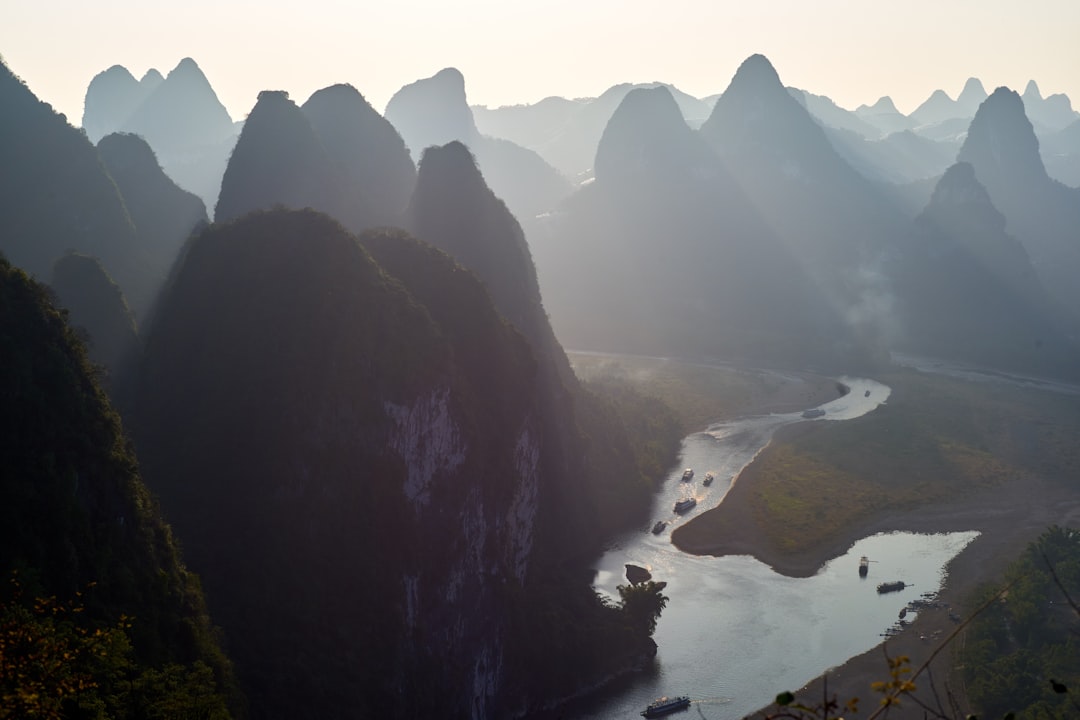
The first thing to understand about Tengchong is that the ground has a memory.
Not in the mystical way travel writing sometimes reaches for when it runs out of specifics. I mean it more plainly. This corner of western Yunnan sits on volcanic earth. The hills are rounded in a way that feels slightly unnatural until you realize they are old cones. Steam rises from hot springs because the landscape is still quietly warm underneath. Even the ordinary parts of town seem to have been built on top of something that has not entirely cooled.
That is the reason Tengchong works on me as an opener to Yunnan’s deeper southwest. It does not announce itself as a destination. It absorbs you slowly, through texture.
Most first trips to Yunnan get pulled into a very understandable triangle: Dali, Lijiang, Shangri-La. The route is famous for a reason. It is scenic, legible, and easy to explain to someone at home: old towns, mountains, lakes, highland air. If you have never been to China and want a beautiful first draft of Yunnan, that triangle does its job.
But it also creates a certain expectation of what Yunnan is supposed to be. Courtyards, coffee shops, silver jewelry, blue skies, clean mountain silhouettes. A version of the province that photographs easily.
Tengchong is less tidy than that, and more interesting for it.
It sits in western Yunnan, closer in spirit to the borderlands than to the postcard circuit. Myanmar is not an abstraction here. The geography presses in. Roads feel like they are moving toward edges. Markets carry that slight cross-border looseness where goods, accents, and habits do not line up perfectly with a single map. The pace is not sleepy exactly. It is watchful.
This is not the China of bullet-train certainty and glass towers. It is also not a preserved village waiting politely for a camera. Tengchong feels lived-in in a way that makes you adjust your speed.
You start noticing small things. The way older men sit in public with the seriousness of people who have no interest in performing leisure. The way a bowl of rice noodles arrives with a broth that tastes less like a recipe than a local weather system. The way the air can shift from damp warmth to mountain cool before you have decided what kind of day it is.
The Geology Is Grammar, Not a Checklist
Yes, Tengchong is known for volcanic landforms and hot springs. You can build a neat itinerary around that. Walk among old volcanic hills. Visit geothermal areas where steam and mineral heat turn the earth into something half domestic, half primordial. Soak in hot water and feel very briefly convinced that your nervous system has been redesigned.
But the better way to read the geology is not as a checklist. It is the town’s underlying grammar.
Hot springs change how a place thinks about rest. Volcanic land changes how a landscape holds shape. Mineral heat turns relaxation into something physical, not decorative. In Tengchong, the idea of taking the waters does not need to be wrapped in wellness language. It is simply what the ground offers.
That matters because so much China travel content makes the country feel like a sequence of sights. This temple, that viewpoint, this food street, that ancient town. Tengchong resists that rhythm. The point is not that there is nothing to see. There is plenty. The point is that seeing is not always the best verb.
Sometimes the better verb is staying.
A First Trip Built Around a Mood
A first trip to China does not have to begin with the national greatest hits. It also does not have to begin with the golden triangle of wherever the algorithm has decided you should go. Beijing–Xi’an–Shanghai has its logic. Dali–Lijiang–Shangri-La has its logic. But China becomes more itself when you understand that a strong first trip can be built around a mood, not just a route.
Tengchong is a good argument for that.
It gives you Yunnan without immediately handing you the version of Yunnan that has already been captioned a thousand times. It gives you mountains without making them theatrical. It gives you old-town texture without requiring every lane to become a souvenir. It gives you food that feels closer to appetite than branding. Most of all, it gives you the southwest as a temperature, not a theme.
Enough Logistics to Stay Open
Tengchong is best approached as a slow stop, not a hit-and-run. If you are already building a Yunnan trip, it makes more sense when paired with time in Kunming or Dali rather than treated as a random detour. Access is possible; the emotional logic of the place is slower than flying in and out. Give it room if you can.
Food is part of that room. Western Yunnan cooking can feel earthy, sour, smoky, herbaceous, and deeply tied to local produce. This is not the moment to hunt for the one famous dish and move on. Pay attention to textures: slippery rice noodles, sharp pickles, grilled things, mushrooms when they are in season, broths that taste quiet at first and then become difficult to stop thinking about.
If China makes you nervous because of logistics, this is also where the unromantic stuff matters. Payment, translation apps, train and flight bookings, menu reading — these are not separate from the emotional experience. They decide whether you have enough mental space to notice the good parts.
That is why I think getting by in China is not a boring topic. It is the foundation for being open. The same goes for learning how to eat without needing every dish translated into a familiar category. A place like Tengchong rewards travelers who can tolerate a little ambiguity at the table and on the street.
Not heroic ambiguity. Just ordinary travel ambiguity.
The Door It Opens
There is a kind of traveler who wants China to become simple before they arrive. I understand the impulse. China can feel large in a way that makes even experienced travelers regress slightly into overplanning. But Tengchong suggests a different bargain: prepare enough to move through the day, then leave some space for the place to remain itself.
That is the door it opens.
Not a door into “hidden China,” which is usually just a phrase people use when they mean “less famous to me.” Tengchong is not hidden from the people who live there, and it does not need outside discovery to become meaningful. It is a door into a lower register of Yunnan: warmer ground, slower streets, border air, food with shadow in it, and a landscape that asks you to pay attention from the soles of your feet upward.
If Dali and Lijiang are Yunnan in conversation with the camera, Tengchong is Yunnan in conversation with the ground.
That may not be the easiest first version of China to explain. It may be the better one to feel.
For two weeks across Yunnan, Guizhou, and Sichuan, I would start with a question before a route: do you want the trip to move slowly, or do you want it to be led by food? The answer changes everything. If you write me with that preference, I can share the editorial skeleton I use — not a booked itinerary, just a frame.
Discussion