
If you only have two weeks in China and you refuse the golden triangle, people will ask you what you are replacing it with.
That question is already the wrong shape. Beijing–Xi’an–Shanghai is not a product you swap for another product. It is a habit: wall, warriors, skyline — then home with a sentence that travels well at dinner. Southwest China does not need a louder sentence. It needs a different temperature.
I would spend the two weeks as a sequence, not as a packing list.
Not fourteen destinations. Three registers. Soft landing. Sour rewrite. Slower ground. Everything else is logistics dressed as culture.
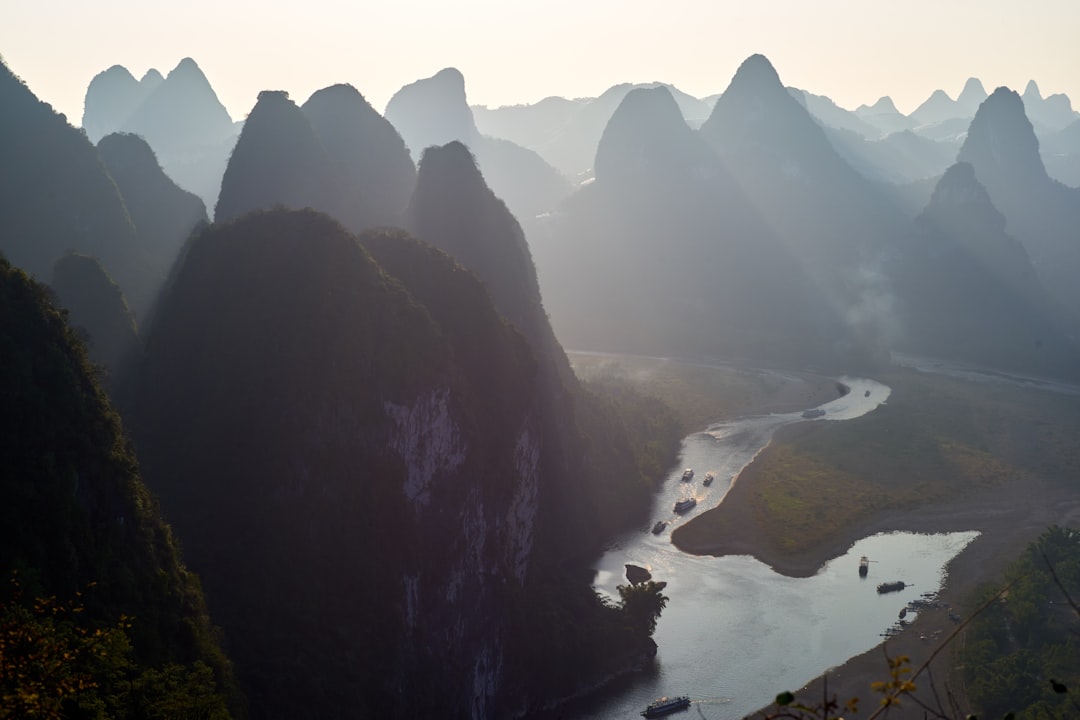
Southwest China rewards pace more than pin density. Photo: site archive / Yunnan light.
Soft landing is a city that forgives you
I would begin in Chengdu — not because it is “the best,” but because it forgives jet lag without demanding a performance of awe.
Most Chengdu trips become a checklist before the suitcase is open. Pandas. A famous hotpot. A night market that photographs like every other night market. That version of the city will feed you and send you home with proof you “did Sichuan.” The version I trust asks for a smaller map: one walkable neighborhood, the same street twice, forty-eight hours of appetite instead of collection.
I have written that geometry as a longer argument — forty-eight hours, one neighborhood, same street twice. Here I only need the function inside a two-week line: Chengdu is the soft landing before Guizhou’s sour rewrite and Yunnan’s slower register. Two or three nights. Not a greatest-hits tour of the metro map. Enough time for morning tea that is not content, a midday bowl that arrives without English explanation, and one evening table you do not rush.
If you only have ten days, you still start here. You just shrink the middle and the end with honesty — not by pretending three cities in two nights is “efficient.”
The sour rewrite is not a day trip
After Chengdu, I would move into Guizhou — and I would protect enough nights that the province can change your vocabulary.
Western itineraries often leave Guizhou blank. When it appears at all, it arrives as a single sharp day: a cave meal, a karst viewpoint, a village photographed into a souvenir. Those days can be memorable. They are not the same as letting sourness become structure instead of novelty.
Guizhou’s table is not “spicy with a twist.” Acidity organizes appetite the way heat does in Sichuan — and landscape sometimes becomes the dining room, which is why a karst cave hotpot is not a gimmick so much as climate logic. I will not turn this skeleton into a booking script. What I will say is practical: give Guizhou two to four nights in a fourteen-day line. Choose one living-culture day or one sharp specialty day, then rest. Do not empty-run both ends of the province to collect names.
If someone asks whether Guizhou is “worth it” after Chengdu, the honest answer is that worth is the wrong verb. The question is whether you want your palate and your pace rewritten before Yunnan slows you further.
The slower register needs ground that remembers
Then Yunnan — and inside Yunnan, I would anchor western ground rather than only the postcard triangle.
Dali–Lijiang–Shangri-La has its logic. Scenic. Legible. Easy to explain at home. It also trains an expectation of what Yunnan is supposed to be: courtyards, coffee, clean silhouettes. Tengchong sits differently. Volcanic earth. Hot-spring rhythm. Border-town patience. The geology is grammar, not a checklist — which is why I treat it as an opener to a deeper southwest mood, not as a secret nobody else has heard of.
In a two-week balance, I would give Yunnan the longest stretch: Tengchong for several nights, then a lighter close toward Dali or Kunming so the exit does not invent a new long line. In a Yunnan-deep version of the same fortnight, I would cut Chengdu shorter or skip the optional Chongqing branch entirely, and let hot springs and morning bowls do more of the teaching than another famous old town.
The point is not that Tengchong replaces every other Yunnan map. The point is that two weeks becomes honest when one place is allowed to set the temperature.
What I would refuse
I would refuse the optional branch that turns the middle into a highlight reel: Chongqing for a skyline photograph, Wulong for a day that looks dramatic on a phone and costs a full transfer. Those can be right for a different trip. Inside fourteen days of Yun–Gui–Chuan, they are usually how the sequence collapses back into collection.
I would also refuse to sell this as a customized itinerary. It is an editorial framework. Preferences are knobs — slower hops, food-forward, one sharp specialty day, fewer city changes — not a passport-by-passport redesign. Hotels, tickets, and agencies stay off this page on purpose.
The only question worth ending on
If you only had two weeks in Yun–Gui–Chuan, would you go slower or eat harder?
Either answer can be correct. What fails is pretending you can do both at full volume and still leave with a vocabulary instead of a slideshow. Soft landing. Sour rewrite. Slower ground. That is the map I trust when the golden triangle is no longer the default sentence.
Discussion